
Google Is No Longer a Search Engine—it’s an AI assistant.
You think EdTech is bad now? Buckle up.

I recently put out a video flagging that Google is no longer a search engine, it is essentially an AI assistant, and has plans to double down on this new direction. And though it was a pretty spontaneous reaction to Google’s announcement of the changes to search…. the video apparently struck a nerve (currently at 3.5m views and 196k likes).
I’ve noticed a few patterns in the comments that I’ve read (which is only a small fraction of the 7,118 comments so far). Since there’s so much interest in the topic, I want to expand on what I mean, why it matters, and why I think we need to be paying attention to this right now.
The tl;dr
Google has been adding AI features to its search box for some time now, and on May 19th announced that they are going all-in on AI, changing the interface from the search box we know, to something that seems to operate more like a chatbot.
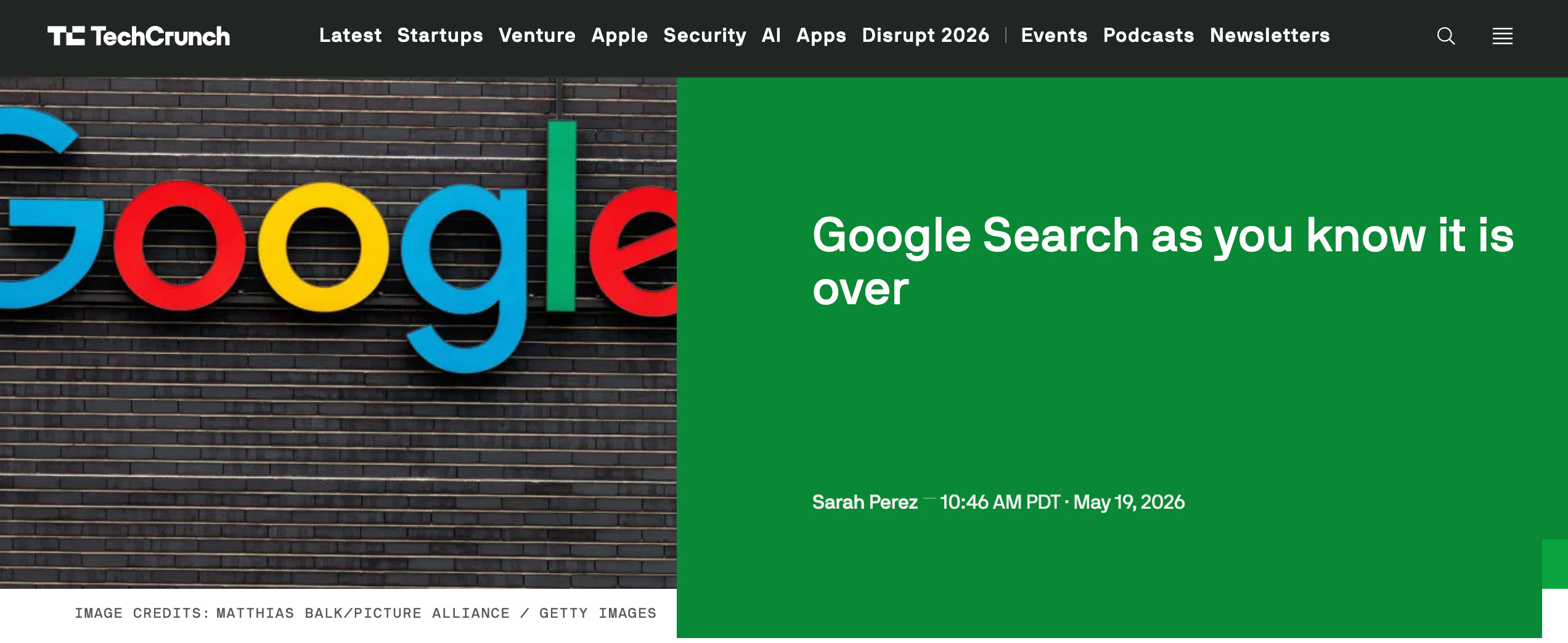
Sundar Pichai called it the biggest upgrade to Google Search in over 25 years, which is a nice way of saying that they are essentially phasing out the product that 90% of all search traffic globally runs through. This is not hyperbole. If you look at what they are saying (and doing) their message is clear: Search as you know it is over. Instead of helping you search for information, we will just provide you what we decide the answer is.
Basically, Search (the product that students and schools globally use as their default research tool) is becoming an always-on AI agent. It is going from a search engine to an “answer” engine.
The search engine itself may still be working much like before, but what has changed is YOUR INTERACTION with it, and your experience of finding what you are looking for. How?
Search is a way to find what you are looking for on the World Wed Web (aka. the internet.) Search engines do this by (among other things) indexing the internet — this is essentially a way of organizing information in order to find it easily. Think libraries. How do you find things in a library? Literally, an index. Someone organized and categorized the information in a way people can explore and find relevant resources.
Ok, so a search engine categorizes / organizes information online and then helps you find stuff that is relevant to what you are interested in.
So now, while Google Search may still technically be operating much the same way under the hood, it is no longer finding and sharing relevant links for you to explore. Instead, it’s finding, analyzing, and synthesizing information… and packaging it up for you as a baked answer. Yes, the blue links are still technically there, but they are no longer the primary response, and are increasingly buried.
To be clear here: I am not talking about “AI summaries,” which is AI appended to search. These changes ultimately amount to search being rebuilt entirely around AI.
This shift means that “searching the web” will increasingly be performed by AI agents rather than humans. Instead, people will focus more on acting on the information those agents provide instead of manually clicking links.
Consider for a moment what it means when the “people” in this sentence are students.
While Google says AI is not the default experience, the user interface encourages users to ask follow-up questions instead of scrolling down to the links, and it’s abundantly clear that this is just the beginning. Even the business and marketing world is now asking itself how it can shift from “search engine optimization” to “answer engine optimization”
I understand that some people might see the changes and think “Great! this is super helpful in all the following ways, and there will be some disruption. Shrug.” Ok… But the collateral damage to kids and in schools will be huge. You think edtech is an issue now? Just wait.
I’m not going to sit here and argue about the direction of search. What I want to do is ring a giant alarm bell for parents and educators, because the decisions Google is making right now have a direct impact on kids and classrooms all over the world.
*By the way, complicating this is that the entire internet seems to be devolving into garbage, but I’ll have to tackle that in a separate post.
Why does this matter?
1. Because whether we like it or not, Google has become invisible educational infrastructure.
Google Classroom is used by between 80-90% of school districts in the United States, and over 80% of the top 100 universities. They have hundreds of millions of users globally, in over 230 countries and territories. Google has become the operating system that our kids use first, and the Google search engine is their front door to the internet — especially when it comes to doing research and homework of various kinds.
All of this makes their choices as a company very relevant to us and our kids, pretty immediately.
2. The search engine results page (SERP) we know has already begun transforming into something personalized to the individual.
This deepens the “filter bubble,” and every problem stemming from it.
FILTER BUBBLE (a term coined by Eli Pariser) = a state of “intellectual isolation” that occurs when internet algorithms selectively personalize the content you see online without you realizing it. It limits exposure to diverse viewpoints, effectively trapping you in a customized information loop that reinforces all of your existing beliefs and patterns. It confirms existing biases, distorts reality by creating a loud echo chamber, and isolates you from anything that diverges from your existing preferences and habits.
You don’t need longitudinal studies to understand that a filter bubble is completely at odds with education.
Why am I focused on Google?
Yes, there are other search engines... but Google matters because:
Google dominates search, period. About 90% of global search runs through Google (and I think that number is higher on mobile) which is an enormous amount of power. To put it more bluntly: they control the traffic (deciding what people see and in what order) which also puts anyone who wants that traffic at their mercy. This is at the heart of how they’ve built their empire.
It is baked into school systems globally. Whether we like it or not, Google has become invisible educational infrastructure. As I said before: Google Classroom is used by between 80-90% of school districts in the United States, over 80% of the top 100 universities, and they have somewhere between 150-170 million users globally, in over 230 countries & territories.
It is our kids’ front door to the internet. Because of this dependency, our kids use Google for everything by default… doing homework, writing reports, creating presentations, and doing research of all kinds. “Digital literacy” — the thing we like to say we’re teaching kids — is largely built around the ability to navigate the internet. And navigating the internet has, for a generation plus of students, meant using Google.
So yes, *YOU* can switch. (Baratunde Thurston has some great advice on this) but schools can’t just flip a switch, because Google is basically load-bearing infrastructure for classrooms ranging from kindergarten to graduate school.
Ok, so what actually changed?
On May 19th, Google announced the biggest changes to Google search in 25 years.
Let’s unpack the changes directly from Google’s official announcement:
1. Default model in AI mode = souped up for agents and coding.
“Starting today, we’re upgrading Search with Gemini 3.5 Flash — our newest Flash model delivering sustained frontier performance for agents and coding — as the new default model in AI Mode for everyone globally.”
The new default model in AI mode is Gemini 3.5 Flash, which is souped up for agents and coding. Ok, fine. They go on to say…
2. It is pro-actively personalized and predictive.
(So the more / longer you have used Google, the more it knows about you…)
“Designed to anticipate your intent, it also helps you formulate your question with AI-powered suggestions that go beyond autocomplete.”
It is “designed to anticipate your intent” … You know how Google already has a bunch of autocomplete suggestions when you type something in the search box? Now it goes further than trying to complete your sentence, and actually tries to help you “formulate your question.”
(By the way, as any educator will tell you, formulating your question effectively is central to learning.)
3. The interface is now essentially a chatbot.
“We’re also making it even simpler to continue the conversation with Search. You can easily ask a follow-up question right from an AI Overview, and flow into a conversational back and forth with AI Mode.”
They are describing a chatbot. So you start with a question that might look like what you’d normally type into a search bar, and then “flow into a conversation…”
I think everyone is largely familiar with the issues and risks that come with chatbots…
Sycophancy
Filter-bubble on steroids
Deepening isolation
Ultimately it is a machine programmed to keep you engaged as long as possible at all costs. How this would be considered for a learning environment for even a nanosecond is beyond me.
(Not to mention the rapidly growing list of cases in which a kid started using a chatbot for homework, and the “conversation” took a dark turn ending in tragedy.)
4. “Information agents” (the prototype for what will become “search agents”) will be operating in the background 24/7.
“We’re entering the era of Search agents, where you can easily create, customize and manage multiple AI agents for your many tasks, right in Search. We’re starting with information agents. Operating in the background, 24/7, these agents intelligently reason across information to find exactly what you need at exactly the right moment.”
(Starts this summer for some users.)
You may have heard of “agents” in terms of AI, but if not… they are basically an automated worker bee that you can point at a specific task, and it does what you tell it, while you do other stuff. What they are saying here is that their goal is for the search bar to be a place where you can launch and manage MULTIPLE AI agents for whatever is important to you, and that the first step in that direction (this summer) is what they call “information agents” that will send you an “... intelligent, synthesized update.”
The difference is something like this: imagine libraries suddenly stopped letting you browse the stacks. Instead, a librarian meets you at the door, asks what you want, and hands you a summary or recommendations that they’ve prepared. You never touch the actual books. That’s what’s happening.
“We’re bringing the power of Google Antigravity and the agentic coding capabilities of Gemini 3.5 Flash right into Search. Search can build the ideal response, in the right format for your question — completely on the fly.”
This means the search bar will also be able to code for you. Sounds kinda like vibe-coding to me, but I know “agentic coding” is technically different. But basically: you can type instructions into the search bar and it will make things for you.
And here’s the cherry on top…
“Finally, for AI to be most helpful, it shouldn’t just know the world’s information, it should understand your context, too. So today, we’re expanding Personal Intelligence in AI Mode to more people in nearly 200 countries and territories across 98 languages — no subscription required. You can securely connect apps like Gmail and Google Photos, and soon Google Calendar.”
Translation: we need all your data so we can make this product useful. We won’t even make you pay for the privilege of letting us hoover up your emails, photos, and entire life schedule. So seriously, give us everything and we promise search will be sorta useful maybe.
I mean. Read the room guys.
“But Emily! We need to teach kids to use these tools.”
Yes, we do. But there’s a *huge* difference between learning how to use technology and using a technology to learn. One builds skills and judgment. The other outsources them.
Also: AI is not a tool. It is the entire process.
What I’m talking about here is the difference between saying you want to learn how to cook, and then practicing meal after meal with various tools, techniques, and ingredients… versus getting a Grub Hub delivery. That is the difference, and you can send me all the hate mail you want… it’s true.
Is it convenient? Sure. Is it learning? Absolutely not.
There were already debates about the value of technology in the classroom. The argument was that they were a tool for learning. How can Google argue that their products are tools for learning and the production of knowledge, when they have turned into tools for consuming pre-packaged knowledge? It is a mediocrity machine at best.
A primary objective of education is learning how to learn. Instead, Google seems to be teaching them how to consume what someone else has crafted in the most mediocre way possible. I would really like to know who is interested in this definition of education.
“AI has always been part of how Google works.”
Technically true. And also beside the point.
I am not talking about the mechanics of what’s running under the hood. The search engine itself may not have changed that much. In fact, I imagine what’s happening is that the product we know is becoming less visible but is still “searching” the internet in a similar way. BUT… what I’m talking about is OUR experience. What is the touchpoint we engage with, and how does it impact our relationship with information.
For a long time, Google’s north star was helping you find what you were looking for. The goal was to get you somewhere useful as efficiently as possible.
That goal has clearly changed. The product is no longer trying to connect you to information. It’s trying to give you a packaged version of their interpretation of information.
“Why would Google do this? Isn’t search their whole business?”
Honestly I don’t know enough about Google to give you a real answer. But I can give you my opinion:
I think that they believe AI is the future of how people interact with the internet, and they need to create demand for it before competitors do. So they’re transforming the product people already rely on, because it’s the path of least resistance. In other words: they decided what the future should look like, and are dragging their customers into that future.
It’s a business strategy, and whether or not it’s a good one for users — especially young ones — is not their concern. Remember: the Google Suite is already integrated into schools across the globe. They are banking on entropy, and the lack of both knowledge and resources to change course.
What now?
So the question this all raises is… what now? What options do schools have? How should schools react to this?
My honest (and very unsatisfying answer) is… I’m really not sure yet.
But what I can say for sure right now is:
If you’re a parent: start asking if your school is aware of the changes to search, and how they plan to adjust this year. If you don’t know what to say, send this to them as a start.
If you are advocating to keep AI out of schools: reframe your argument upstream of AI… to the products the school is using. The truth is that AI is already integrated into products schools are using, and “keeping AI out” might not be as simple a proposition as you might think. This is far more complicated than opposing a product, because Google is essentially woven into the workflow of schools. The decision is not a simple one, and will likely require investment of both time and money.
(And if you’re an educator or decision-maker in a school, and you’d like to talk, DM me. I’d really like to think through this with people who are actually in classrooms.)

More on the changes to Google Search
Mashable crisply lays out how Google Search is changing forever, and what that means for navigating the internet.
This interesting look at what happens to the internet if no one clicks search links.
Time’s coverage of the changes and implications for industry.
This list of Google algorithm updates sorted by release dates, for anyone who wants to take a nose-dive into that rabbit hole.
Check out nilay patel’s theory of “Google Zero,” aka the moment when Google Search stops sending traffic outside of its search engine. He wrote this two years ago, and I haven’t stopped thinking about how he describes how “the entire web is Google’s platform.” He talks about this largely from a web traffic and market perspective, but boy are the implications for the education massive.
Brain Snacks


Home Screen is a multimedia project grappling with how technology is shaping our lives, relationships, and kids. Subscribe to stay in the loop.
Congrats on going viral, Emily. Assume you saw Seth Godin’s recent tangential post mentioning zero clicks too: https://seths.blog/2026/06/blogs-traffic-and-google/ . Keep up the good fight.