ICYMI // July 14
(In Case You Missed It) Stuff happening in tech that is relevant to your kids, classrooms, and lives.

Here’s what caught my attention this week (and the past few weeks)…
This buried iPhone feature turns your smart phone into a “dumb phone.”
Meta created an AI feature that allowed any user to tag a public Instagram account and ask the chatbot to create new A.I. photos based on it… The consent for this was on by default for public accounts. It quickly (and very predictably) went to a dark place, and Meta pulled down the new feature. While I’m glad the media was quick to cover it (and that Meta reacted) the bigger problem is that companies assume they can do stuff like this. And why wouldn’t they? Tech companies have been allowed to operate as if the rules of our world do not apply to them. They paused for now, but as we speak, they are building more AI features and integrations for WhatsApp, Facebook and Messenger, and I am sure video is next.
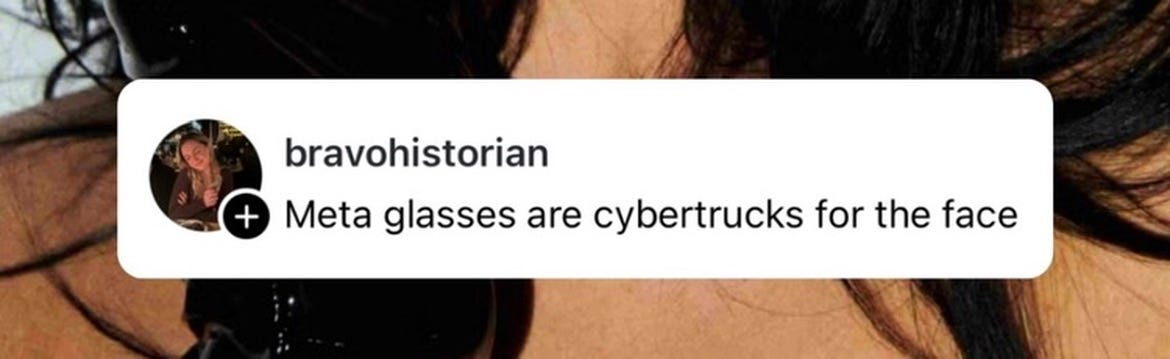
In a move that will pretty instantly be weaponized (especially against women and children) Meta apparently embedded face-recognition technology for its smart glasses into Meta’s AI app. While it’s not fully operational yet, they’ve essentially put all the pieces in place for what would ultimately be a global facial-recognition system based out of a consumer product. And this is apparently not new… it’s a restart of a facial recognition system that they shut down several years ago due to privacy concerns. BTW I am FAR more worried about this than social media.
On a related note… It turns out people who have Meta glasses are paying people on Facebook marketplace to remove the light that indicates they are recording… so the people around them won’t have any indication they are being recorded. (Maybe because the backlash is so strong that owners are afraid to wear them in public. Good.)
Henrico County, Virginia (home to 37 data centers) sent its schools an email asking employees to “conserve electricity.” The county expects a 25% rise in electricity costs next year, adding an estimated $5 million to its budget. Employees were advised to close the blinds and turn off their computers (yes, seriously) while 17 more data centers are being built. It remains unclear to me why schools are footing the bill for AI infrastructure expansion.
Stephen Fitzpatrick wrote a fantastic essay about how the biggest threat AI poses to students is not what it does to their writing, but what it does to reading. He argues that when students offload reading to AI summaries, they never build the foundational vocabulary, background knowledge, and cognitive patience that make it possible to read anything complex, including AI output itself. The students who use AI most effectively, he found, are the ones who already read and write well. In other words… It’s widening the gap, not closing it (as supporters argue it will).
Waymo called the cops on two 15-year-olds. The teens were allegedly drinking and shooting toy guns, which triggered a “safety response.” This is a very slippery slope, and all I will say right now is this: automated systems have a long and well-documented history of errors (see examples here and here) and when lives and reputations are on the line, allowing a robot on wheels to preemptively call the cops is asking for trouble and tragedy. Remember: these systems reflect the beliefs and assumptions of the people that create them, and the context that they were “trained” in.
AI clinical documentation tools are hallucinating nonexistent medical issues in patient records. A special report out of a Canadian audit warned that AI medical scribes were “not evaluated adequately,” and may present “fabricated information.” These tools claim to reduce administrative burden, but they are creating far more of a problem… and clinicians are essentially being forced to use them.
AI isn’t exactly going as planned… CEOs of countless companies are not seeing a return on ROI. Mark Zuckerberg, admitted that AI isn’t working out the way he imagined, Google’s Gemini ran a coffee shop and was kind of a disaster, and software developers are saying that AI is rotting their brains. I hope those advocating for AI in schools are taking note…
Meta’s AI data center leaked Legionella bacteria into a town’s irrigation water. The cooling systems used in large-scale data centers require enormous amounts of water and create conditions where Legionella (the bacteria that causes Legionnaires’ disease) can thrive. If Legionnaire’s sounds familiar, it’s because there’s an outbreak in Manhattan right now. I am not saying data centers lead to Legionnaire’s disease… but. BUT. This is probably worth considering as people grapple with the impact of data centers on neighborhoods and communities. (Because apparently cooling systems are a common source of the bacteria.)
I wanted to end with a quote from my incredible friend & colleague Stephanie T. Nguyen who recently wrote about how to ban surveillance pricing — the pretty universally opposed practice of companies using your data to price gauge you. This quote in her recent article is a perfectly stated reminder that what these companies create and do is a policy choice. And it absolutely applies beyond surveillance pricing:
“In a political climate where voters are looking to elected officials to stand up to abuse and to deliver results, policymakers must remain vigilant. Anything less is a failure to govern at a time when working people are becoming live test subjects, absorbing all of the economic and social risks of transformative technologies.”
Sources & mentions this week: 404 Media, NPR, Futurism, Forbes, Euronews, Stephen Fitzpatrick, Stephanie T. Nguyen, Lee Hepner, The Capitol Forum, NPR, ACLU, BBC, Joanna Stern , WIRED
Brain Snacks