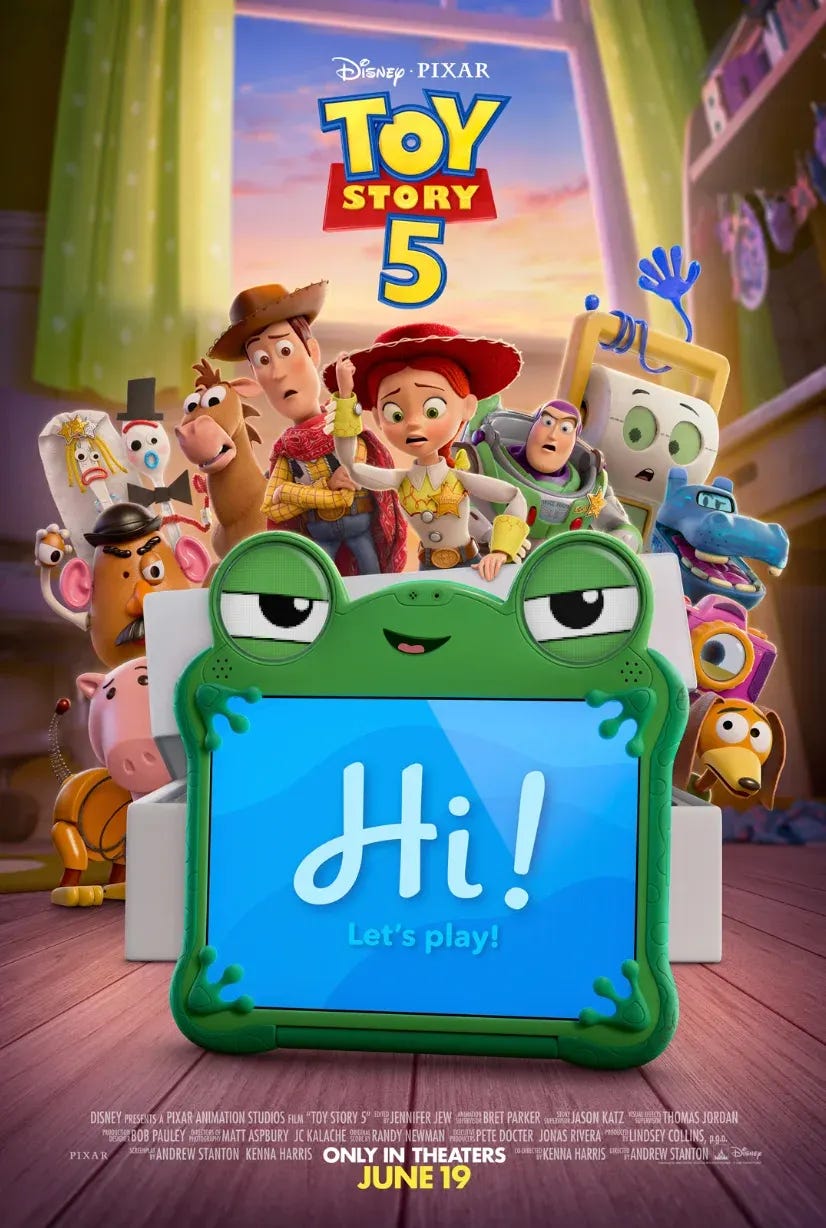
Toy Story 5 gets it.
Connection, FOMO, group chats, shrinking childhoods, optimization culture, and the uncomfortable truth that parents are part of the problem.

I know I’m late to the review party, but since many of you have asked me what I thought of the movie, I wrote a few thoughts down.
In short: I absolutely loved it. Like the kids say: 10/10. They nailed it… on so many levels. It presents a complex topic with nuance, care, and even love. I cried… several times.
For those who haven’t seen it yet, the basic plot is this:
The little girl that we met in Toy Story 4 (Bonnie) is shy, and having a hard time connecting with other kids. Her parents want to help, so they buy the toy that all her peers are using (a tablet) hoping that it will help her connect with other kids and make friends. Very quickly, Bonnie gets sucked into a platform that demands and reinforces time on the device, as opposed to what she is more personally interested in: unstructured creative play with her toys. But she essentially gets peer-pressured into using this thing that she actually doesn’t like. The main turning point comes from the most drama-filled corner of devices: a group chat.
There are so many reasons to love this movie, but here’s what especially stood out to me:
1/ The parents and toys are all trying to help, but they take different approaches.
(… and while well-intentioned, the parents’ approach makes everything worse.)
This was instantly fascinating to me, and is a tension that the movie captures perfectly in the first few scenes. The toys and the parents are both worried about the same thing, and desperately want to help. While the parents succumb to group-think and social pressure, and take the path of least resistance (they just buy the tablet), the toys seek to understand the root of the problem, and discover that the tablet is what’s stopping kids from doing what Bonnie wants to do most: unstructured imaginative play.
The tragic irony that the movie sets up beautifully from the first few scenes, is that everyone cares about Bonnie, and wants her to connect with other kids and build relationships. But the parent’s hyper-focus on what other kids are doing leads them to overlook what their daughter actually wants and needs — which is other kids who share her interests, and a space in which to pursue them.
2/ The entire plot was about connection and relationships — and what devices do to both of those things.
So much of what we hear about kids and tech is dominated by content and contacts: what kids are consuming, and who they are interacting with. What we hear far less about is the less tangible, less measurable impact of technology: how it shapes our experiences, relationships with others, and ultimately with ourselves.
Throughout the movie, we see devices replace (not facilitate) relationships, and even erode Bonnie’s own sense of self. I found myself wishing I could see the Inside Out version of Bonnie’s brain throughout the movie — get on it, Disney / Pixar!
As the toys discover when Jessie investigates the neighborhood, devices have become a wall between people, preventing them from interacting in the most basic of human ways. From house to house, Jessie sees kids and parents all consumed by whatever is happening on the screen in front of them… even when they are sitting right next to each other. And then we watch as the device (and all the people pushing it) leads Bonnie to abandon herself in pursuit of someone else’s idea of friendship. (BTW Snapchat is extremely guilty of this.)
3/ The FOMO is real…
The “fear of missing out” that children experience is hard to quantify, but is something that parents around the world have seen in their homes regularly. When I spoke to parents about the movie, this is the part that seemed to resonate most universally.
This experience was on full display when Bonnie wakes up and Lily Pad has no batteries. She completely freaks out, and unravels in a panic. Her dad scrambles to get it working again.
This tracks with research about the effect of Snapchat on kids, and how “streaks” create an obsessive relationship with the app, rooted in a fear of missing out. For example: studies in Austria and Belgium found that teens share their Snapchat passwords so others can maintain their streaks when they cannot. The FOMO situation related to social media is a global phenomenon, though from what I see in my homeland (Greece) it’s less intense… possibly because the kids have so many unstructured in-person alternatives.
4/ Childhood is being shortened
This I found extra fascinating, and extra painful. In several moments, the movie points out that childhood is being cut short. In one part, kids tease Bonnie for “still playing with toys.” In another moment, Jessie is in Blaze’s room, and as she looks around exasperated, she shouts something along the lines of: This doesn’t look like a kids room!!! Where are the toys?! Where is the mess?! Why is it so clean?
Preach, Jessie.
Childhood happens once, and it flies by. Grass-stained clothes, dinosaurs set up for fights for weeks on end, stuffed animal classrooms, piles of cool sticks and rocks their found stuffed into jars (and sometimes random parts of their closet…).
We should be protecting it all — not turning them into mini adults.
I’m not advocating for chaos and disorder. We should still teach them to put their things away, and/but… there’s some degree of mess that comes along with a brain that is learning and exploring the world through play. (FWIW, the line I draw is for toys that are set up for a particular purpose… not just random toys and clothes thrown on the ground because they can’t bother to put it away.)
5/ The drama comes from a group chat.
The drama and heartache is not coming from some creep on social media… (though yes, those exist.) It’s coming from social dynamics among peer groups, in a group chat.
Every single parent I have spoken to has a group chat story. Every. Single. One.
The public narrative is very focused on social media as the enemy. I don’t disagree that it’s awful, but it’s also an incomplete story. And if we actually want to address any problems, we have to be clear-eyed about where kids are actually spending time with their peers, and what is happening.
Unfortunately for us, researchers follow grant money, and social media is the hot ticket right now — not chat groups. So even though people working with kids every day can see that online bullying is worse when school is in session, and group chats are a huge source of conflict… the quantitative data does not seem to be there (yet).
But as I’ve said a thousand times: parents need to make decisions right now, and there has to be room for observable reality… like: group chats are clearly a significant source of drama and heartache.
6/ The “old school” technology highlights that every generation of technology has promised convenience and personalization.
I love this one. The old school tech is a cute throw-back that highlights two critical points:
Every generation of technology has been sold as a convenience, and promises to “solve” a problem that technology cannot actually solve, and
In the world of technology and consumer-facing products, “connection“ is something to be achieved. It’s a box to check, a thing to obtain… It is not connection. It is “a connection.“
In one scene, the Lily Pad argues with Jessie… saying that I know her, I want to help, and the kids are HERE! These are the arguments parents everywhere have been hearing for years: this is where the kids are, these products understand your kids better than you do and can help because personalized blah blah blah. YOU NEED ME…. Jessie sees right through it, and claps back that those are not real relationships.
We (especially in the United States) are so focused on optimization and measurable outcomes, that we often forget that the things we need most — and the very things that make us human… that make us feel alive, worth something, and loved — are not measurable.
Digital products create the illusion of connection by making it visible and measurable, while eroding the very skills and experiences that lead to real and lasting connection. Our obsession with metrics and optimization is killing our (and our kids) souls. AI is taking this to the next level.
7/ The role of the parents.
This one is hard. The very uncomfortable reality that they surface in the movie is that parents play a huge role in all of this. Yes, it’s a collective problem, and I am fully aware of the complexity. But the movie very tactfully demonstrates how parents factor into things. It is the PARENTS who….
… use technology constantly, and they are frequently holding a cellphone or on their computer.
… accept the notion that this is just what friendship looks like now, and follow the crowd (without considering that perhaps this is not the right crowd for their kid…)
… buy the tablet and just hand it to their (very) young kid with zero direction or guidance.
… allow their kid to use the tablet completely unattended.
… leave the tablet in the kids’ room overnight.
… allow kids at a sleepover to bring their tablets and spend their entire sleepover on them.
I am sympathetic to the fact that parents have been largely in the dark about digital products, including what they are, how they work, and what the impact on kids can be. It’s easy to assume that the products our kids have include some sort of limitations or guardrails, just as is true with so many other products we buy. But we now know enough to be certain that this is not true, and that the danger zone is in ANY internet-connected device and algorithmically-driven experiences.
I have three young kids ranging between Bonnie and Blaze’s ages. I am acutely aware of the realities and challenges of being a working parent with young kids, and understand the draw of just handing a screen to a kid because how the hell else am I supposed to get everything done and have just 10 @#$%ing seconds during which 3 kids are not simultaneously asking me for something.
And/but… it’s time we accept the fact that we are part of the problem. Not me or you specifically. But all of us. We did this to them, collectively. (And so did our policymakers.)
It’s not THEIR fault they grow up thinking this phone has magical properties, or that it’s THE symbol of adulthood. We carry around these products as if our lives depend on them.
It’s not THEIR fault that kids don’t play outside.
It’s not THEIR fault that the only opportunity they have to play is in highly structured activities with constant adult supervision (and often direction).
It’s not THEIR fault that some parents monetize their children online, and create entire subcultures of kids content that mirrors adult content (like Get Ready With Me routines, and home organization products).
It’s not THEIR fault that their parents don’t know that the products they are using are literally designed to exploit their weaknesses in order to absorb every ounce of their attention at all times.
And it’s definitely not THEIR fault that our policy-makers have allowed and even enabled all of this to happen, in the name of innovation.
I could go on but you get the picture. It is time we WAKE UP, and take control of our own relationship to devices, because our kids are watching us. If we behave as if the phone is the most important thing in the room, they will believe that it is.
7/ The fix comes from a moment of trust.
The devastated little girl shows her mom what happened on the device. The mom listens, and responds with love and care.
Build that trust now, because this moment is coming for all of us.
Final thoughts…
I found the movie really refreshing, especially considering the overly simplistic takes that we see all over the media portraying tech as either the entire problem, or the entire solution.
Somehow, the crew behind Toy Story 5 understands what is ultimately an incredibly complex and multi-faceted problem, and communicates it in a way that is clear, relatable, and even uplifting. They focus on relationships, connection, and unstructured imaginative play — because THAT is what adds up to the beating heart of childhood.